
Summary
Supercomputer provides insight into the complex systems needed to effectively run 200 million euros of code.
Supercomputer: what happens
The MareNostrum V supercomputer, located in a 19th-century chapel, is managed using SLURM schedulers and fat-tree topologies. This advanced infrastructure utilizes 8,000 nodes to enable large-scale computations and data processing. It operates on technology that supports efficient and scalable pipelines, which is essential for complex computing tasks.
Why this is important
For BI professionals, this development offers significant insights into data processing and the infrastructure required for powerful computational systems. Investments in supercomputers like MareNostrum V highlight the increasing need for robust data analysis infrastructures in science and industry. Competitors in this space include other high-performance computing facilities and cloud-based data processing solutions. This phenomenon reflects a trend where organizations are increasingly relying on complex systems for diverse analyses.
Concrete takeaway
BI professionals should be aware of the technological infrastructure necessary for executing demanding data analyses and should explore opportunities to integrate supercomputing facilities into their own analyses.
Deepen your knowledge
Knowledge Base
ChatGPT and BI — How AI is transforming data analysis
Discover how ChatGPT and generative AI are changing business intelligence. From generating SQL and DAX to automating dat...
Knowledge BaseAI in Power BI — Copilot, Smart Narratives and more
Discover all AI features in Power BI: from Copilot and Smart Narratives to anomaly detection and Q&A. Complete overview ...
Knowledge BasePredictive Analytics — What can it do for your business?
Discover what predictive analytics is, how it works, and how to apply it in your business. From the 4 levels of analytic...
Related articles

How to Run Claude Code Agents in Parallel
The new feature for Claude Code Agents allows users to execute multiple code agents in parallel, significantly boosting ...

How to Create Production-Ready Code with Claude Code
Practical guide to writing production-grade code with Claude Code and other coding agents.

Code Less, Ship Faster: Building APIs with FastAPI
Guide to building APIs with FastAPI: path operations, Pydantic models, dependency injection, and automatic documentation...
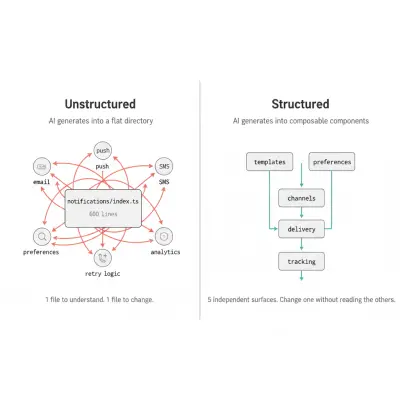
The Black Box Problem: Why AI-Generated Code Stops Being Maintainable
Why AI-generated code becomes unmaintainable without structure, and how structured generation solves this problem.