
Summary
Google Cloud launches TurboQuant, an innovative solution that minimizes the VRAM issue with KV cache.
Google Cloud addresses VRAM issue with TurboQuant
Google Cloud has unveiled TurboQuant, a new framework for KV cache quantization that tackles excessive VRAM usage. By employing multi-stage compression and technologies such as PolarQuant and QJL residuals, TurboQuant enables users to manage large context windows with minimal memory overhead. This makes it an essential tool for organizations dealing with large datasets and machine learning models.
Why this matters
This development enters a market increasingly driven by data growth and the need for effective data analysis. Competitors like Microsoft Azure and Amazon Web Services are also working on solutions for efficient data management. TurboQuant aligns with the broader trend of cloud-based AI and analytics tools that help organizations optimize their data infrastructure. For BI professionals, this means new opportunities to achieve data analysis capabilities with fewer resources.
Concrete takeaway
BI professionals should keep an eye on TurboQuant as a potential game changer for data analysis. It offers an opportunity to improve the efficiency of their systems while keeping costs low.
Deepen your knowledge
Knowledge Base
ETL Explained — Extract, Transform, Load in plain language
What is ETL? Learn how Extract, Transform, and Load works, the difference with ELT, and which tools to use. Clearly expl...
Knowledge BasePredictive Analytics — What can it do for your business?
Discover what predictive analytics is, how it works, and how to apply it in your business. From the 4 levels of analytic...
Knowledge BaseData Lakehouse Explained — The best of both worlds
What is a data lakehouse and why does it combine the best of data warehouses and data lakes? Architecture, comparison, a...
Related articles

Beyond Prompt Caching: 5 More Things You Should Cache in RAG Pipelines
Optimizing RAG pipelines can significantly enhance AI model efficiency.

4 Pandas Concepts That Quietly Break Your Data Pipelines
Issues with Pandas can quietly disrupt data streams, leading to significant repercussions for your analyses.

Building a Production-Grade Multi-Node Training Pipeline with PyTorch DDP
A new approach to building a multi-node training pipeline with PyTorch DDP enhances the efficiency of deep learning mode...
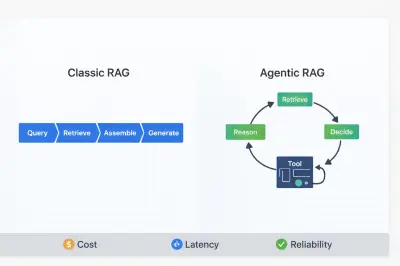
Agentic RAG vs Classic RAG: From a Pipeline to a Control Loop
Comparing Agentic RAG and Classic RAG: when to choose adaptive retrieval loops versus simple pipelines.